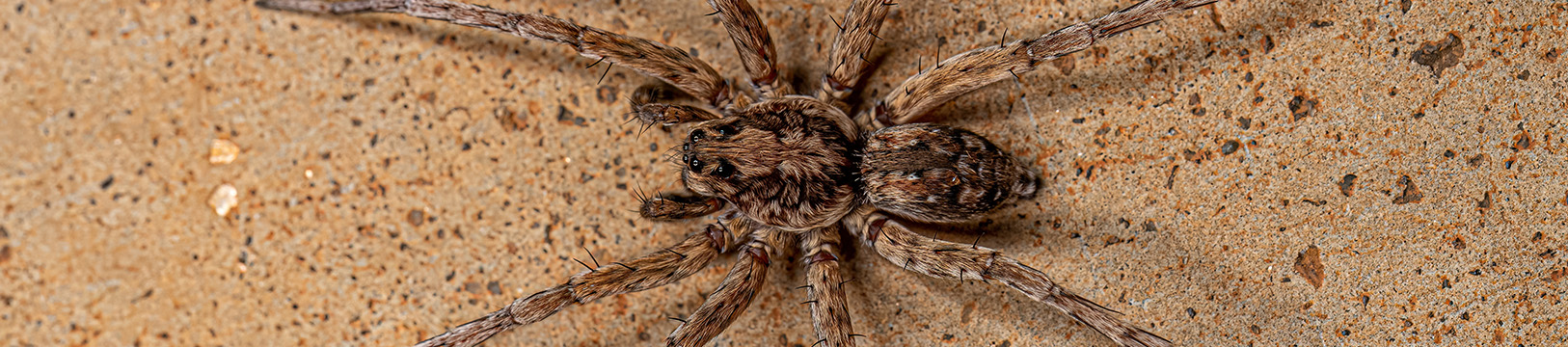
Wolf spiders are common ground-hunting spiders found throughout Northwest Florida. Some species grow quite large, and their hairy bodies and quick movements can make them startling when they turn up indoors.
Unlike spiders that wait for prey in a capture web, wolf spiders actively hunt insects and other small arthropods. They usually live outdoors in lawns, gardens, leaf litter, landscaped areas, and other places where they can find cover and prey.
Wolf spiders occasionally wander into homes, garages, and businesses, but finding one indoors does not necessarily mean they are breeding inside.
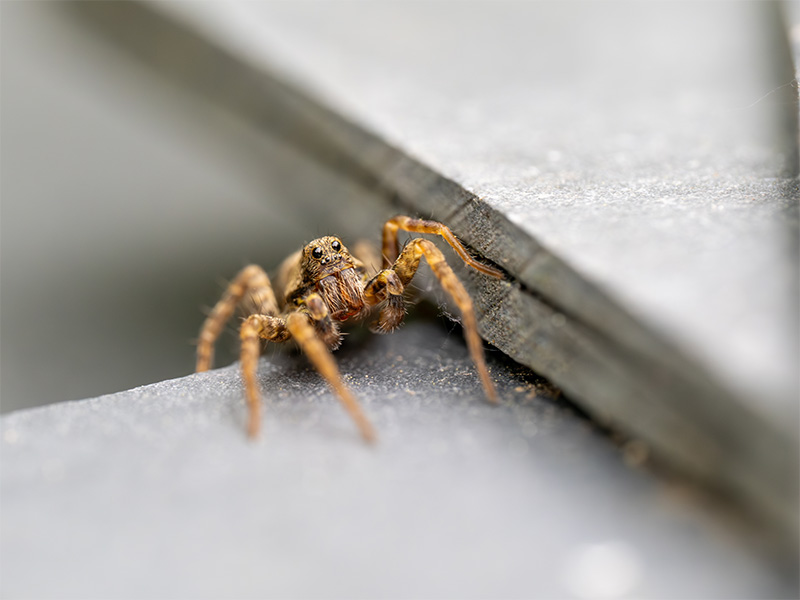
Wolf spiders vary considerably by species, but their sturdy build, ground-running behavior, and distinctive eye arrangement can help distinguish them from other spiders.
Wolf spiders vary widely in size. Depending on the species, the body may range from roughly 1/4 inch to more than 1 inch long, with the legs making larger species appear considerably bigger.
Most are shades of brown, tan, gray, or dark brown, often with stripes, chevrons, or mottled markings that help them blend into soil, grass, and leaf litter.
Wolf spiders generally have sturdy, hairy bodies and strong legs adapted for running and capturing prey.
Wolf spiders have eight eyes arranged in three rows, including a pair of particularly large eyes. Their eyes can reflect light when illuminated at night, which is why a flashlight across a lawn may reveal small points of eyeshine.
Wolf spiders can be encountered throughout much of the year in Northwest Florida, but activity is generally easier to notice during the warmer months when both spiders and their insect prey are active. Some species also become more conspicuous when mature males begin wandering in search of females.
Wolf spiders spend most of their time at or near ground level, where they can hunt and take shelter.
Common hiding places include:
Some species shelter in burrows or protected retreats during the day and emerge to hunt, often after dark.
If a wolf spider wanders indoors, it is often found along floors, baseboards, garages, and other ground-level areas.
Finding a wolf spider inside usually means it wandered in from outdoors rather than that your home has a spider infestation.
Open doors, garage doors, damaged weatherstripping, and gaps near ground level can provide access. Outdoor areas with grass, mulch, leaf litter, or dense landscaping can also support wolf spiders, as these habitats provide shelter and hunting opportunities.
Prey can play a role as well. Because wolf spiders hunt insects and other arthropods, areas with plenty of prey can support more spider activity.
Wolf spiders are not considered medically significant spiders and generally try to escape when disturbed. They can bite if trapped against the skin or handled, but typical reactions involve temporary pain, redness, and localized swelling rather than serious injury.
Wolf spiders are also beneficial predators outdoors because they feed on insects and other small arthropods. Their presence becomes a concern for most homeowners when these large, fast-moving spiders begin appearing indoors.
One especially distinctive behavior belongs to females: they carry their egg sac attached to the spinnerets at the rear of the abdomen. After the eggs hatch, the spiderlings climb onto the mother's back and ride there until they are ready to disperse.
Patriot Pest Management's year-round residential pest control includes spiders and many of the household pests they feed on. If wolf spiders are turning up inside your home, our team can address the infestation and provide ongoing treatments to help keep pests under control.
We also provide commercial pest control for offices, warehouses, healthcare facilities, and other businesses throughout Northwest Florida.
Wolf spiders do not build webs to catch prey. They hunt on foot, although they still use silk to construct retreats and egg sacs.
After her eggs hatch, a female wolf spider carries the spiderlings on her back until they are ready to disperse. Before hatching, she carries the egg sac attached to the rear of her abdomen.
No. Wolf spiders do not eat wood, damage building materials, or cause structural damage. They are predators that feed on insects and other small arthropods.
Call Patriot Pest Management at (850) 332-9299 or request a free quote online, and we'll help you take the next step.

5 stars all around, courteous, prompt, communicated exactly with he was doing and how to keep the pets safe! Pay that man! It was simple, easy and fast!
Tim F.
Pensacola, FL

Mario with Patriot Pest is fantastic to work with. He’s professional, easy to communicate with, and always delivers great customer service. Highly recommend Carlos and the team with Patriot Pest Management!
Rebekah K.
Pace, FL

When other companies came up short, Patriot Pest found the solution and delivered results. They arrive on time, communicate clearly, and stand behind their work with integrity. Great people, outstanding service, and a company you can trust. If you need pest control done right the first time, Patriot Pest is the company to call.
Jesa S.
Pace, FL






Helpful Tips & Info